
The short answer: PMP is an evidence-and-judgment pathway
Earning the Project Management Professional certification is not simply a matter of purchasing a course and memorizing a book. The current pathway has four connected gates. First, you must meet one education-and-experience combination. Second, you must satisfy the project-management training requirement or qualify for the active-CAPM credit. Third, you must submit an accurate application that can withstand verification. Fourth, you must demonstrate project-leadership judgment on a 180-question, scenario-oriented examination. Every stage depends on evidence, and PMI makes the final eligibility, audit and certification decisions.
The most effective starting point is not “How quickly can I book?” Start with “Which requirement can I prove today, and what evidence is missing?” Gather education records, map non-overlapping months of project leadership, locate training certificates and read the current Exam Content Outline. This work prevents a candidate from studying for months only to discover that a credential was classified incorrectly, two projects were double-counted or a training activity did not satisfy the formal-hour requirement.
The July 2026 examination also makes an important mindset visible: project success is broader than delivering scope on time and budget. Candidates must reason about value, stakeholder outcomes, delivery approach, governance, risk, organizational change, sustainability and the changing business environment. Predictive, adaptive or agile and hybrid work appear across the domains. A useful preparation program therefore connects concepts with decisions rather than teaching one fixed sequence for every project.
Do not purchase training, an exam payment service or a voucher quote because a salesperson says you are eligible. Compare your facts with PMI’s current requirements, retain verifiable evidence and submit only information that accurately describes your work.
What changed when PMI updated the PMP exam in July 2026?
The July 2026 update was a blueprint change, not a new credential. PMI still awards the PMP certification and still evaluates whether a candidate can lead projects responsibly. What changed is the relative emphasis placed on the setting in which that leadership occurs. The Business Environment domain grew from 8% to 26%, while People and Process retained substantial weight. A candidate should therefore learn how a project creates useful outcomes and how external shifts affect a plan, not merely how to produce a schedule or recall a process name.
| Domain | Previous blueprint | July 2026 blueprint | What changes in your study |
|---|---|---|---|
| People | 42% | 33% | Continue practising conflict, leadership, stakeholder understanding and team performance in context. |
| Process | 50% | 41% | Connect planning and delivery controls to the approach and to decisions that preserve value. |
| Business Environment | 8% | 26% | Give more attention to governance, benefits, compliance, external change and organizational outcomes. |
PMI also highlights AI, sustainability, stakeholder engagement and value delivery across the current outline. Those terms do not mean every question is about a new tool or a sustainability metric. Imagine a team proposing an AI assistant to draft status reports. The project leader would check data classification, human accountability, accuracy and stakeholder needs before allowing it to influence a decision. For sustainability, a procurement choice might need to balance immediate cost with lifecycle impact, contractual obligations and sponsor expectations. The exam asks for a defensible next action in a specific situation.
Approximately 40% of the new items represent predictive delivery; adaptive or agile and hybrid approaches share the remaining 60%. That distribution is a guide to preparation, not a reason to memorise a single response pattern. The same stakeholder concern may call for formal change control in one governed project and backlog reprioritisation in another. Read PMI’s 2026 exam update together with the current Exam Content Outline; older prep materials may describe a different domain mix or an incomplete eligibility path.
Step 1: choose the eligibility route you can document
The July 2026 Exam Content Outline lists four routes. All require professional project-management experience gained within the ten years before application. The experience must involve leading and directing projects, and months cannot be counted twice when projects overlap. The education credential determines the minimum number of non-overlapping leadership months. Use the route supported by official education evidence, not the route that sounds closest to a job title.
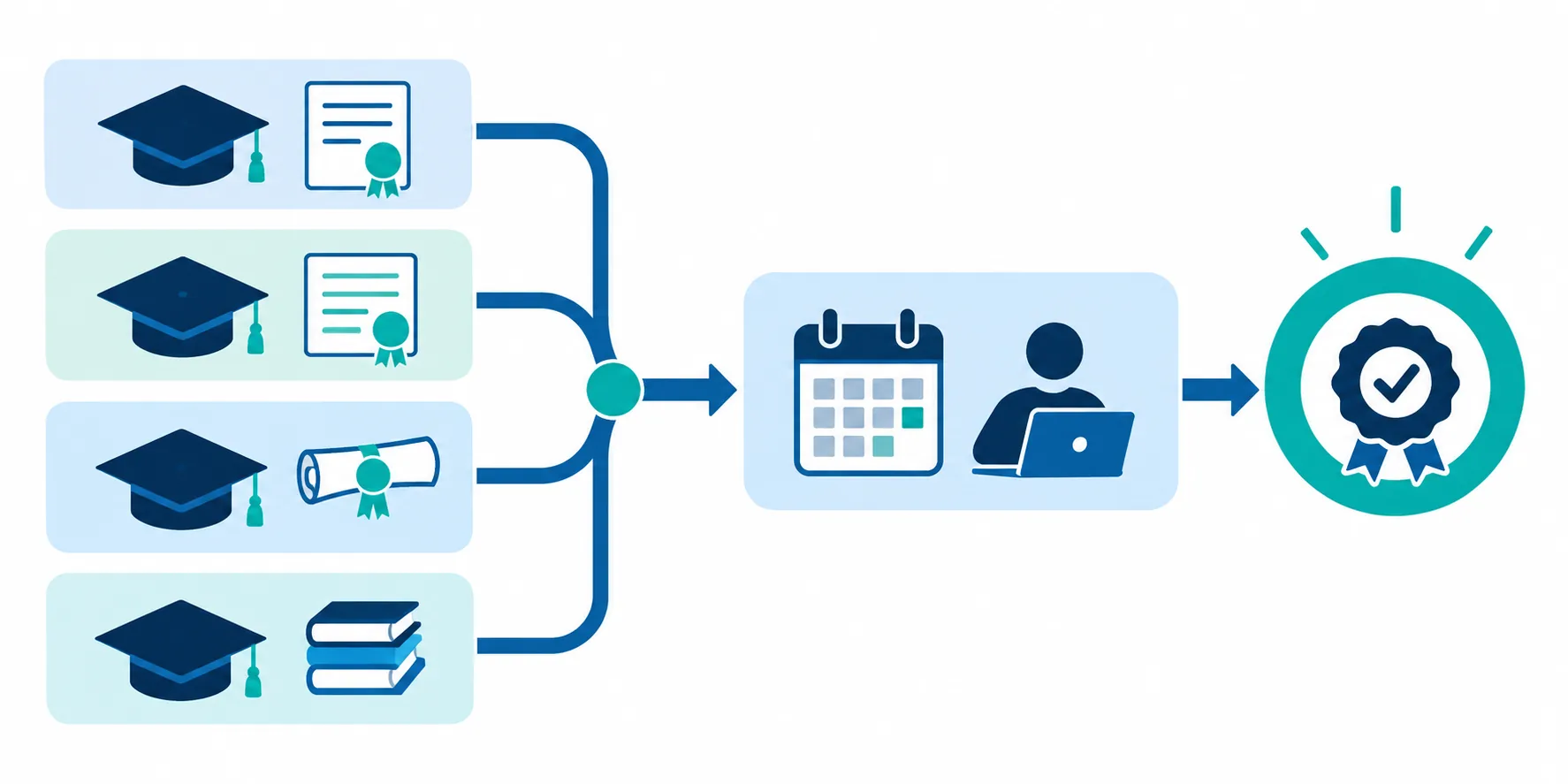
Secondary or upper-secondary qualification
This route covers a recognized high-school diploma, GED-type equivalency or comparable upper-secondary completion. The project-leadership experience must have been gained in a professional setting during the ten years before application.
Associate, higher-certificate or advanced vocational qualification
Use this route when the credential is formally recognized at the applicable post-secondary or short-cycle tertiary level. A title such as advanced or professional does not prove its framework level by itself, so retain official education evidence.
Bachelor’s degree or higher
The degree must come from a recognized or authorized institution. A non-degree professional or vocational award belongs here only when a competent authority formally maps it to a bachelor-equivalent level.
Bachelor’s or postgraduate degree from a PMI GAC-accredited program
This reduced experience route applies to a qualifying degree program accredited by PMI’s Global Accreditation Center. Confirm the program—not only the institution—in the current GAC directory before relying on this path.
What counts as project-leadership experience?
A project is temporary work in a unique context that creates value. Your experience can come from different industries, delivery approaches and job titles. You do not need to have held the exact title “Project Manager,” and the work does not necessarily have to be paid. You do need to show professional responsibility for project decisions and outcomes. Examples may include planning delivery, aligning stakeholders, managing risks or issues, guiding a team, coordinating dependencies, controlling change, measuring results or transitioning an outcome. Routine operations, recurring administration, school assignments, degree research, personal events and home-improvement work do not qualify merely because they required organization.
Separate projects from operations by asking whether the work had a defined change or outcome, a beginning and an end, and a group of stakeholders working toward that result. Launching a new service, implementing a platform, migrating a data estate or redesigning a business process may be projects. Processing the same monthly report, maintaining a stable service without a defined change or performing a permanent administrative duty is generally operational work. A role can contain both; describe only the qualifying project component.
How to calculate non-overlapping months
Imagine that Project Alpha ran from January through June and Project Beta ran from April through September. Each project lasted six months, but the combined eligibility period is January through September: nine unique months, not twelve. List both projects separately in the application, then count the shared April–June period once. Create a month-by-month timeline before entering information. This is safer than adding every project duration and trying to correct overlaps later.
Check the ten-year window from your intended submission date. A project can be genuine and well documented yet fall outside the current eligibility period. If a project crosses the boundary, verify with PMI how the relevant months should be handled instead of making an assumption. Keep source dates consistent across your résumé, application, supervisor verification and project records.
| Evidence check | Useful preparation | Common mistake |
|---|---|---|
| Education level | Degree, diploma, transcript or an official framework-level record. | Assuming a marketing title proves bachelor-equivalent status. |
| Professional setting | Employer, client, nonprofit or other accountable professional context. | Using a personal or academic activity because it felt complex. |
| Project dates | One calendar showing every project and the unique eligible months. | Adding durations and counting overlapping months twice. |
| Leadership work | Decisions, responsibilities, delivery approach, stakeholders and outcomes. | Listing only technical tasks, team activities or job-description language. |
| Verification contact | A supervisor or manager who can verify the experience if requested. | Submitting claims before confirming that evidence still exists. |
Step 2: complete and preserve evidence for 35 training hours
In addition to the education and experience route, PMI currently requires at least 35 formal training hours in project management aligned with topics in the PMP Exam Content Outline. An active CAPM certification gives a candidate credit for this training requirement, provided the other education and experience conditions are met. Graduates of qualifying GAC-accredited programs may also be able to count relevant coursework. The training can have been completed earlier; the important questions are whether it was formal, relevant, complete and verifiable.
PMI’s 2026 outline describes eligible training routes, including PMI Authorized Training Partners, China Registered Education Providers, accredited academic programs, employer-sponsored programs, training companies and self-paced on-demand courses that include an end-of-course assessment. The delivery format and completion date now matter: the broader live-training routes apply to training completed before 1 December 2026; live classes from that date follow PMI’s more limited provider rules below. Only the project-management portion of a broader course counts. One hour of relevant instruction equals one training hour. Reading books, watching unrelated videos or completing practice exams alone does not satisfy the requirement.
Keep a certificate or provider letter showing your name, course title, completion date and hours. Retain the syllabus, provider contact information and payment or enrollment record. If one academic course met three hours per week for fifteen weeks and all instruction was relevant, the outline illustrates how it may represent 45 hours. If only part of the course addressed project management, record only that portion. Never increase the number to reach 35; complete additional eligible instruction instead.
Live-training eligibility changes on 1 December 2026
PMI says live instructor-led training completed from 1 December 2026 qualifies only when delivered by a PMI Authorized Training Partner, China Registered Education Provider or eligible accredited academic program, including GAC programs. Training completed before that date remains eligible under the previous rules. PMI says self-paced courses can still come from any organization. Verify the specific course, delivery provider and completion evidence against PMI’s published training notice before enrolling. ITCertPath cannot decide whether PMI accepts a course.
Ask for the delivery provider’s legal name, live or self-paced format, start and completion dates, number of eligible hours, end-of-course assessment where applicable, syllabus, certificate wording and refund terms. If the live class will finish on or after 1 December, verify the provider’s eligible status before paying.
Review ITCertPath’s PMP learning outline or request PMP training details on WhatsApp. A course listing is not itself proof that PMI will accept the hours.
Step 3: build a truthful, reviewable PMP application
Prepare the evidence before opening the final application form. Create one education record, one training record and a separate worksheet for each project. For every project, record organization, title or objective, dates, your role, delivery approach, leadership responsibilities and outcome. PMI’s current outline says projects are recorded individually. Use clear professional language that explains what you led and why it mattered, while remaining faithful to the actual work.
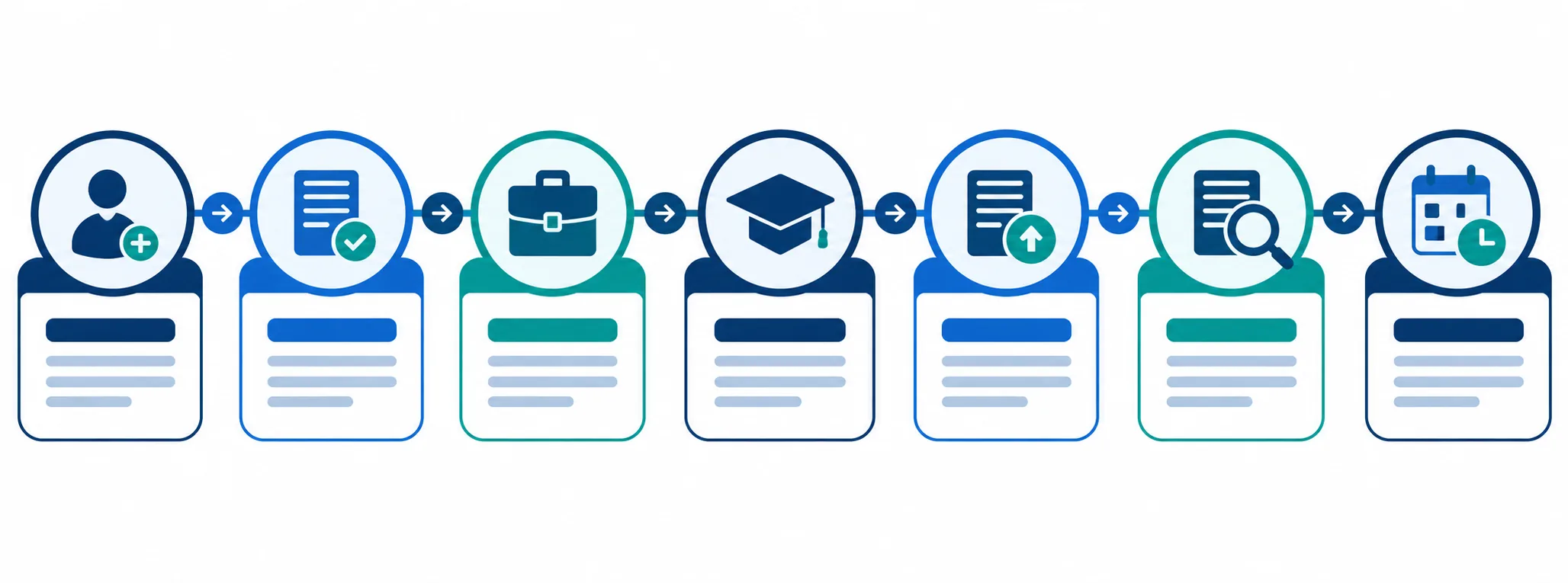
- Create or sign in to your own PMI account and read the current PMP eligibility instructions.
- Select the education route you can prove; calculate unique project-leadership months within the prior ten years.
- Record formal training details or active CAPM credit, and preserve the underlying certificate.
- Enter each genuine project separately with accurate dates, responsibilities and outcomes, then review before submitting.
- If PMI selects the application for audit, supply only the evidence requested in the official notice.
- After acceptance, inspect the exam fee in your own PMI account, pay there and schedule an available appointment.
- Check the appointment confirmation, identification rules and test-day requirements before arriving or launching online proctoring.
A strong project description is specific enough to verify but not overloaded with confidential business details. Start with the project objective and value. Explain your leadership scope across relevant stages: how you aligned stakeholders, chose or applied a delivery approach, planned work, managed risks or dependencies, handled change, supported the team, monitored results and closed or transitioned the outcome. Do not paste process definitions, write a job advertisement or claim ownership of work performed by someone else.
Objective and context
State the temporary initiative, the problem or opportunity and the intended result. “Implemented a regional customer-support platform to replace three disconnected tools” is more reviewable than “worked on a software project.” Remove restricted client data while preserving meaningful context.
Your leadership responsibility
Describe decisions and accountability using accurate verbs: facilitated, planned, prioritized, negotiated, coordinated, evaluated, resolved, monitored or transitioned. Avoid saying “managed everything” when responsibility was shared. A technical lead can show project leadership without inventing budget or people authority.
Outcome and evidence
Record what was delivered, accepted, transitioned, stopped or learned. Use truthful measures when available, but do not manufacture revenue, savings or percentages. An outcome may include validated capability, reduced cycle time, regulatory readiness or an informed decision not to continue.
Verifier readiness
Confirm that a supervisor or manager understands the project and can verify your work if PMI requests it. Preserve their current contact route and advise them that an audit may require a signature. Do not coach a verifier to approve an inaccurate description.
An application-writing example
Suppose a candidate led the rollout of a new service-management platform. A weak description says, “Managed scope, schedule, cost and stakeholders using agile methodology.” It is generic and does not reveal the initiative or the candidate’s decisions. A stronger description could explain that the candidate aligned support, security and business stakeholders around a phased rollout; established acceptance and transition criteria; coordinated backlog priorities and vendor dependencies; monitored delivery and adoption risks; escalated an integration constraint; facilitated a decision to separate one feature into a later release; and completed operational handover with lessons learned. Every statement must be true and supported by the actual project.
Review the application as if you were an independent assessor. Can the reader identify a temporary project, your leadership contribution and an outcome? Are dates internally consistent? Does the education route match the required experience duration? Do the training hours have evidence? Is confidential information protected without making the description meaningless? Only submit after these answers are clear. PMI controls the form and may change fields, so use the instructions shown in your current account rather than copying an old screenshot field by field.
Review the PMP application and 35-hour guide to organize your own information, or get PMP application guidance. Do not send confidential employer records or identity documents through an open chat.
Step 4: prepare for audit without treating it as a failure
All applications are subject to audit, although PMI selects only a percentage. Selection does not mean a candidate has done something wrong. It means supporting evidence must be provided before continuing. The June 2026 Certification Handbook says the electronic audit notice describes what to submit. Typical requests include copies of education credentials, experience verification signed by the relevant supervisors or managers, and certificates or provider letters for the recorded training hours.
The handbook currently allows 90 days to submit requested documents and says a complete audit should take approximately five to seven business days to review. Your PMP process cannot continue until the audit is completed. Follow the current dashboard instructions because document upload, signature and submission methods can change. Keep original files readable and do not edit evidence to make it resemble a different credential or duration.
Before application
Create an evidence folder with education documents, training certificates, course details, a project calendar and verifier contacts. Compare names and dates across records.
If selected
Read the entire notice, list every requested item and clarify an unclear requirement with PMI rather than guessing. Contact verifiers early and give them the accurate project description they are being asked to confirm.
Before submission
Check that every file is complete, legible and attached to the correct requirement. Retain a copy of the submitted package and the confirmation.
After completion
Keep the evidence. PMI states that it can audit at other times, including after certification. Continue only when your eligibility status and payment instructions are visible in the official account.
Step 5: understand the July 2026 PMP exam before studying
The current examination contains 180 questions and provides 240 minutes: 170 scored items and ten unscored pretest items mixed into the exam without being identified. PMI lists two 10-minute breaks, the first after the case-study section and the second approximately midway through the independent questions. Once you close the relevant section and begin a break, you cannot return to questions in that completed section. Practice should therefore include section closure, time decisions and the discipline to move forward.
The blueprint is organized around three domains: People at 33%, Process at 41% and Business Environment at 26%. These are not isolated chapters. A scenario can combine team conflict, delivery risk, governance and business value. Approximately 40% of items represent predictive project management, while the remaining 60% is divided between adaptive or agile and hybrid approaches. Do not study agile as a separate island or assume that every formal governance question must be predictive.
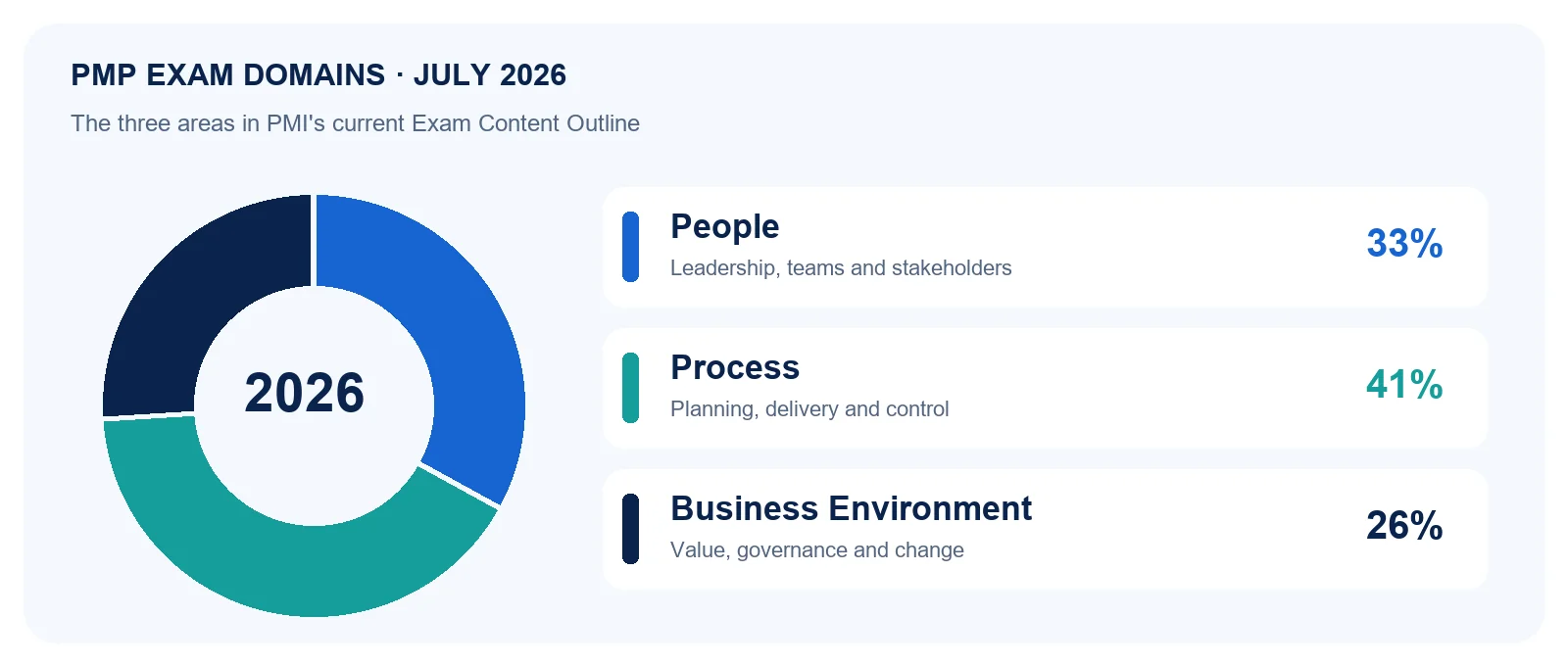
People
People tasks include developing a shared vision, managing conflict, leading the team, supporting performance, engaging stakeholders, building shared understanding, transferring knowledge and planning communication. Preparation should focus on how a leader creates conditions for progress rather than immediately escalating, replacing a team member or imposing a solution. Diagnose the cause, involve the right people, select an appropriate response and confirm that understanding or performance improved.
Process
Process covers the integrated plan and delivery approach, scope, schedule, resources, procurement, finance, quality, change and project or phase closure. The 2026 outline asks candidates to consider complexity, sustainability, dependencies and continued business value. Learn how information flows between plans, backlogs, forecasts, risks, issues, change decisions and acceptance. A correct response should fit both the delivery approach and the project’s governance.
Business Environment
Business Environment now carries substantially more weight than in the earlier exam. It includes governance, compliance, value and benefits, impediments and issues, risk, continuous improvement, organizational change and external changes such as regulation, technology, markets or geopolitics. Candidates need to connect project decisions with the organization and customer, not optimize a schedule while ignoring whether the outcome remains valuable or compliant.
Question types and exam behavior
The official outline describes multiple-choice single- and multiple-response items, case or scenario sets, graphic-based questions, enhanced matching, point-and-click, matching and pull-down interactions, with some formats dependent on the delivery modality. A case may provide several questions against the same detailed situation. A graphic may require interpreting a chart, diagram or other visual evidence. This means preparation must include reading, prioritization and interpretation—not only recalling vocabulary.
For each item, identify the project context, delivery approach, current stage, role boundaries, immediate problem and requested action. “What should the project manager do first?” is different from “What should the project manager have done?” or “Which document should be updated?” Read the final sentence before analyzing options. Eliminate actions that bypass assessment, ignore stakeholders, violate governance, hide information, punish the team without diagnosis or implement an unapproved change.
| Exam signal | Reasoning question | Typical trap |
|---|---|---|
| First or next | What information, collaboration or assessment is needed before action? | Jumping directly to escalation or implementation. |
| Predictive change | Has impact been assessed and the authorized process followed? | Changing baselines informally because the idea is valuable. |
| Adaptive work | Who owns priority, how is value learned and what can the team inspect? | Forcing a predictive approval chain onto every backlog decision. |
| Team conflict | What is the cause, urgency and durable resolution needed? | Escalating before facilitating an appropriate direct conversation. |
| Risk becomes issue | Which planned response, owner, escalation or corrective action now applies? | Continuing to treat an occurred event only as future uncertainty. |
| External change | How does the change affect compliance, scope, value, risk or governance? | Protecting the original plan without reevaluating business impact. |
Predictive, agile and hybrid delivery: choose the approach that fits
Predictive delivery suits work where requirements and constraints can be defined early enough to plan a meaningful baseline. Consider a regulated facilities upgrade with a fixed approval sequence: the team can plan major work packages, inspect progress against agreed scope and assess formal changes before altering commitments. Predictive does not mean stakeholders stop learning; it means the authorized plan and change path remain important controls.
Agile or adaptive delivery is useful when the solution must be refined through frequent feedback. A product team developing a customer-service portal might release a narrow feature, observe whether users can complete a task, and reorder the backlog based on evidence. Its controls include visible work, clear product ownership, feedback cadence and quality standards. Agile is not permission to skip governance, hide risks or change priorities without considering stakeholder effects.
Hybrid delivery deliberately combines controls. A hospital might need fixed safety and procurement gates while developing a digital experience iteratively. The project leader can define which decisions require formal approval and which product details can evolve within those boundaries. In a PMP scenario, identify the source of uncertainty and decision authority before choosing a technique; a hybrid label alone does not tell you who may approve a change.
| Decision dimension | Predictive | Agile or adaptive | Hybrid |
|---|---|---|---|
| Requirements | Relatively stable and baselined. | Prioritized and refined through feedback. | Fixed constraints with evolving solution details. |
| Change | Assess impact and use authorized change control. | Product owner and team reprioritize within capacity and goals. | Apply the control defined for the affected part of the work. |
| Evidence of progress | Accepted deliverables and forecast against plan. | Working increments, outcomes and feedback. | Both milestone assurance and increment-level learning. |
PMP study plans for 30, 60 and 90 days
A timeline is a planning tool, not a pass promise. Start with a diagnostic and the official domain tasks. Mark each capability as explainable, applicable with help or independently usable, then allocate time to your weakest important decisions. A candidate with recent predictive, agile and hybrid experience may need more exam-format practice; another may need deeper financial, procurement or governance learning.
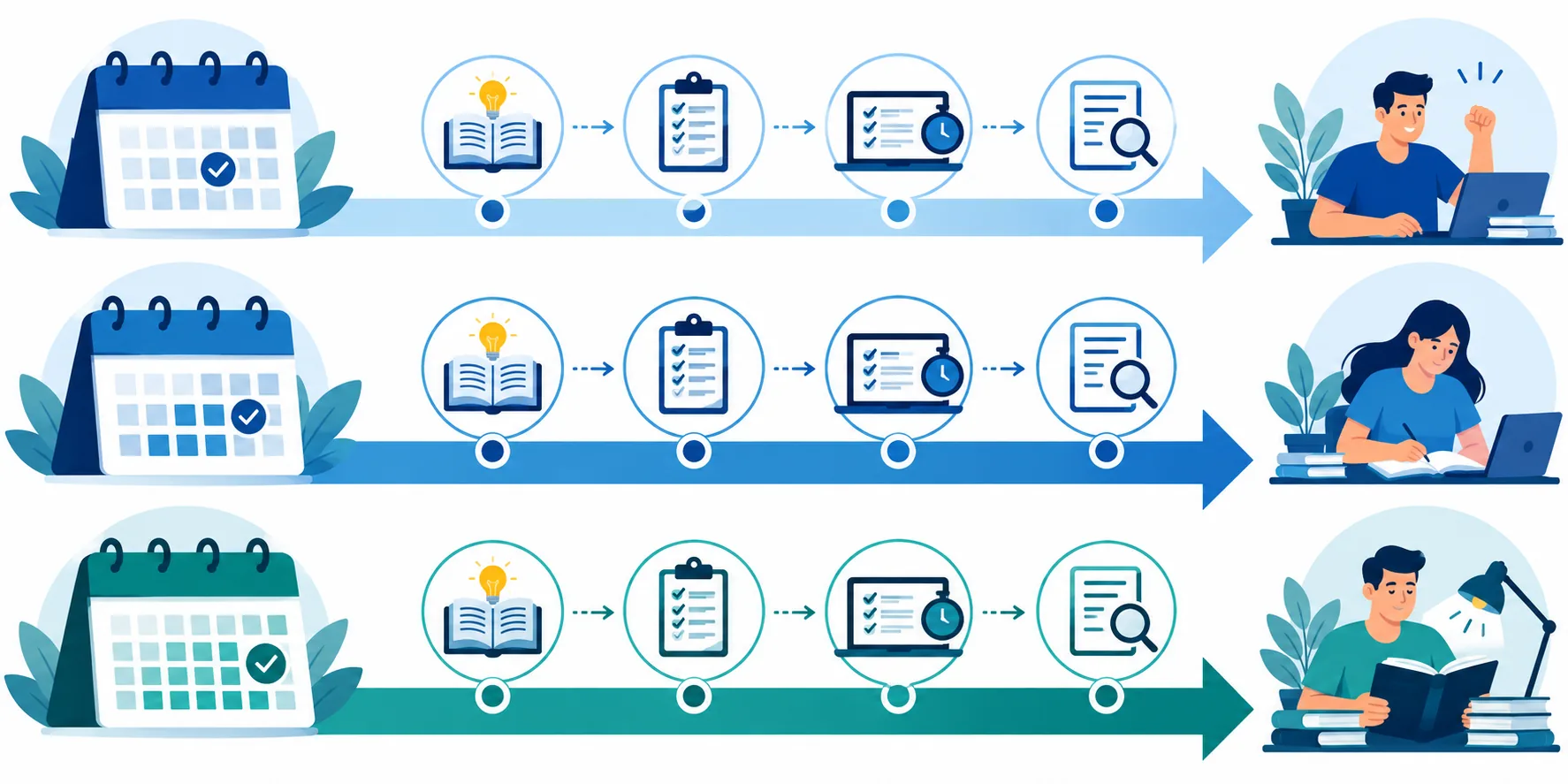
Choose a 30-, 60- or 90-day preparation window
| Window | Best fit | Milestones and practice cadence |
|---|---|---|
| 30 days: accelerated | Eligibility and 35 hours complete; strong diagnostic and reliable daily time. | Week 1: blueprint and weakest domain. Week 2: mixed delivery decisions. Week 3: timed blocks and one fresh full simulation. Week 4: repair errors, complete a second fresh check and confirm logistics. |
| 60 days: balanced | Working candidate with a moderate concept gap and steady weekly sessions. | Weeks 1–2: training and People. Weeks 3–4: Process and Business Environment with scenarios. Weeks 5–6: first timed concept review, focused repair and timed mixed blocks. Weeks 7–8: separately vetted full-format practice, confidence check and test-day preparation. |
| 90 days: measured | Limited weekly time, an incomplete training requirement or a large baseline gap. | Month 1: eligibility, training and core concepts. Month 2: approach comparisons and domain practice. Month 3: two spaced full simulations, weak-topic revision and booking only when results stabilize. |
These are planning templates, not universal pass formulas. Give Business Environment enough time despite its shorter list of familiar process terms; it now accounts for 26% of the outline. After each practice session, explain one decision aloud without looking at the answer. Schedule the real exam based on consistent performance on fresh scenarios and clear reasoning, not on reaching a predetermined calendar date.
Use a repeatable review rhythm
For each week, combine concept learning, untimed reasoning, timed scenarios and an error-log review. Take a break period so fatigue is not mistaken for lack of knowledge. In the final stretch, rehearse the two breaks and appointment logistics rather than cramming new material.
Your error log should record the scenario signal, your assumption, the correct decision rule, the supporting source and the next action. “Wrong answer: B” has little learning value. “I treated an issue as a risk and failed to execute the agreed response” tells you what to study and practise. Group repeated mistakes. When several errors arise from not identifying the delivery approach, fix that classification skill before memorizing more terms.
Use timed concept reviews for diagnosis, not as exam simulations
A mock exam cannot guarantee that you will pass, and it should never contain confidential or recalled live questions. Its purpose is to expose gaps under realistic reading and time pressure. Good practice follows the public blueprint, provides reasoned explanations and separates People, Process and Business Environment performance. It also uses fresh scenarios so improvement is not merely recognition of repeated wording.
Take the first set before the end of your study plan. Review correct answers that were guesses. For each missed item, decide whether the gap was concept knowledge, context classification, sequencing, role authority, delivery approach, reading or time management. Study the smallest concept that explains the error, apply it in a new situation and then continue. Reserve another full set for later validation rather than taking all available tests in one weekend.
ITCertPath links to five 180-item PMP concept reviews with a 240-minute timer, section breaks, scoring, domain review and explanations. Underlying decisions recur with changed context, so these are not five full exam simulations or 900 distinct scenarios. Combine them with the current PMI outline, formal training, detailed course material, real project reflection and separately vetted full-format practice.
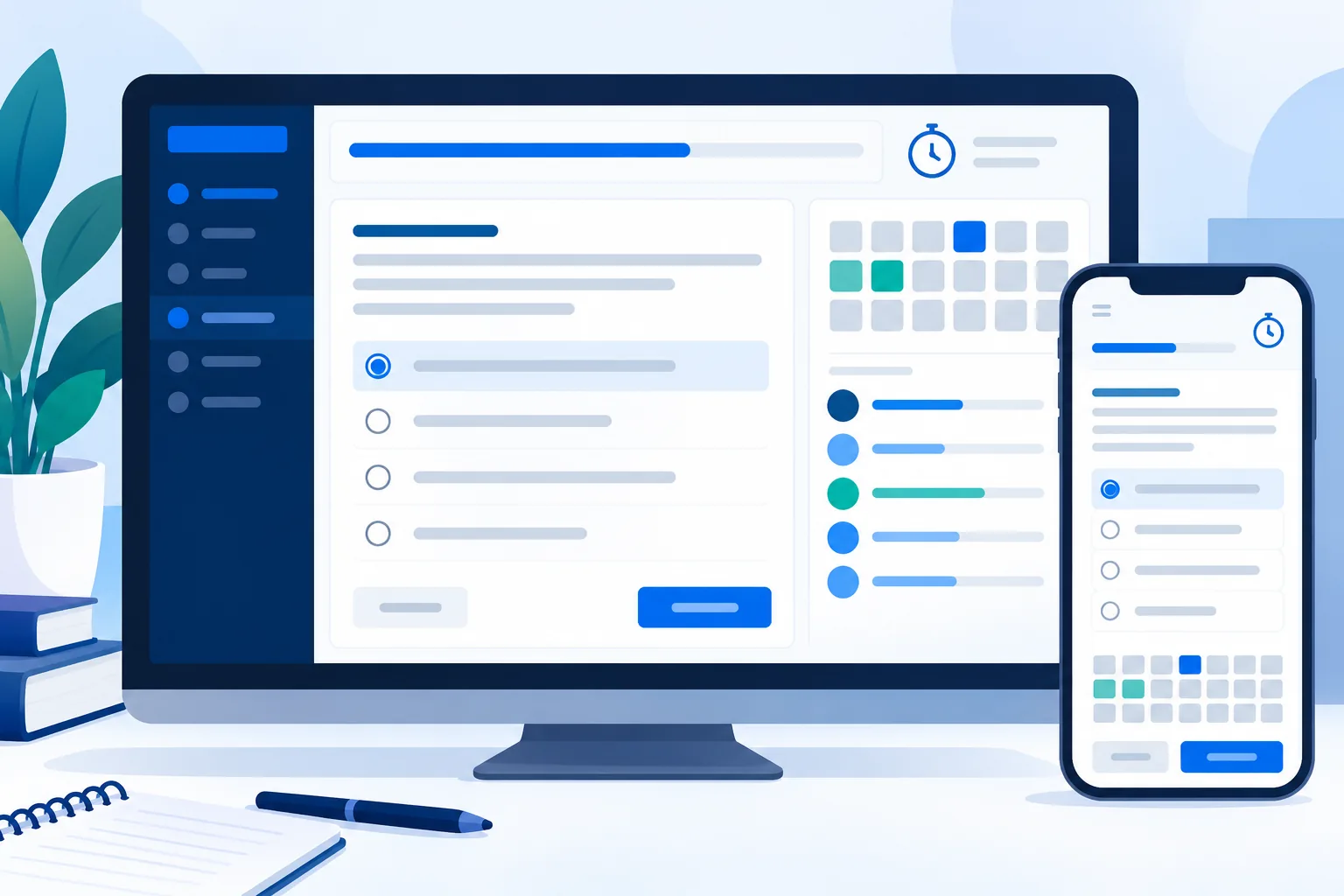
Five original sample scenarios with explanations
These short ITCertPath teaching examples are not PMI examination items. Read each question as a decision problem: identify the stage, the delivery approach, the authority and what evidence is still missing before you act.
1. A design conflict blocks a team
Two specialists disagree about an interface. Both claim their approach will meet the acceptance criteria, and the dispute is slowing the team. What should the project leader do first?
- Escalate immediately to the sponsor for a final decision.
- Facilitate a discussion using the criteria and evidence to understand the disagreement.
- Replace one specialist to restore productivity.
- Choose the cheaper proposal without consulting the team.
Answer: B. First clarify the source and impact of the conflict and create a fair decision path grounded in requirements. Escalation may become appropriate if authority or timing requires it, but using it before understanding the issue is premature. Replacing someone or deciding on price alone ignores evidence and team relationships.
2. A sponsor requests a late feature
A predictive project has an approved scope baseline. The sponsor asks for an additional feature that may improve value but could delay a regulated release. What is the best next step?
- Add the feature to the current work immediately.
- Reject the request because the baseline is fixed.
- Assess benefits, schedule, risk and compliance impacts, then follow the authorized change process.
- Ask the team to work overtime without changing the plan.
Answer: C. A valuable idea still needs impact analysis and the applicable decision authority. Automatic acceptance bypasses governance, automatic rejection ignores value, and hidden overtime makes the plan unreliable. The correct action protects both the business case and the integrity of approved commitments.
3. A regulation changes during delivery
A new privacy requirement takes effect before a planned product release. The current design may no longer comply. What should the project leader do first?
- Keep the schedule and let operations address privacy after launch.
- Consult compliance and affected stakeholders, assess the impact, then obtain the needed decision.
- Cancel the project without analysis.
- Hide the risk until the next routine report.
Answer: B. Compliance and value must be reassessed with the right specialists and governance. Neither ignoring the rule nor canceling without evidence is defensible. The analysis may lead to a change, delay or stop decision, but that decision should be informed and documented.
4. Feedback changes an agile product priority
After a small release, users abandon a feature the team planned to expand. A different workflow appears more valuable. What should the project leader support?
- Complete the original backlog regardless of feedback.
- Ask the product owner and team to examine the evidence and reprioritize toward the outcome.
- Delete all acceptance criteria to move faster.
- Issue a formal baseline change for every backlog item even when the team has no such governance.
Answer: B. Adaptive work uses real feedback to refine priority while keeping quality and authority clear. Continuing known low-value work wastes capacity; removing acceptance criteria weakens quality. The appropriate change mechanism follows the project’s actual governance rather than an assumed universal process.
5. AI-generated status reports contain sensitive data
A team starts using a public generative-AI tool to draft status updates that include client details. No data-use review has occurred. What should the project leader do?
- Continue because a person checks the final report.
- Pause the unapproved data flow, classify information, involve security and define human-review controls.
- Ask the model to promise not to retain information.
- Delete the issue from the risk log to avoid concern.
Answer: B. Human review does not undo an unapproved disclosure. The leader should establish permissible data handling, security and accountability before resuming use. A tool’s conversational assurance is not a control, and hiding the risk undermines governance.
Look for stable performance on fresh questions, balanced domain results, a workable pace, correct use of breaks and the ability to explain why the best option fits. A single high percentage on a familiar set is not enough evidence to book.
Try the free PMP concept-review series to find learning gaps; use distinct, current practice for later validation before booking.
PMP certification cost in India and the United States
PMI’s public certification page displayed a USD 405 member price and USD 655 full price when reviewed on 29 October 2026, and it states that the exam fee is required after the application has been accepted and the candidate is ready to schedule. Do not treat those figures as a universal final checkout amount. Membership is a separate purchase, and taxes, currency conversion, location and price changes can affect the total. Compare the complete member route—including membership cost and useful benefits—with the full price shown in your account.
| Cost component | India candidate | United States candidate |
|---|---|---|
| PMI public PMP exam reference | USD 405 member / USD 655 full price, checked 29 October 2026; not a guaranteed local checkout quote. | |
| Local checkout | Confirm INR conversion or displayed currency, applicable tax and card charges in your own PMI account. No universal INR fee was publicly verified. | Confirm the current USD total and any applicable tax in your own PMI account. |
| Training and practice | Optional provider-dependent costs. Ask for written hours, format, materials, assessment, support and refund terms before comparing offers. | |
| Retake | A current universal retake amount was not publicly verified. Check the charge and remaining eligibility in your PMI account before paying. | |
Membership is not an exam voucher. PMI’s membership store displayed a separate annual fee when checked, but a candidate should calculate the actual combined membership and exam total at purchase time, not assume a guaranteed net saving. Training fees and mock-test fees also vary by provider and are not included in the PMI public exam figure. A lower advertised price is not necessarily a better offer if it omits taxes, learning hours, cancellation rights or a valid registration route.
| Check | Question to ask | Evidence to retain |
|---|---|---|
| Application approval | Is the official PMI account eligible for payment and scheduling? | PMI status and eligibility notification. |
| Final price | What is the complete total for my region, including membership or taxes? | Current official checkout and written quote. |
| Exam identity | Does the payment apply specifically to PMP and this candidate? | Product description, candidate details and receipt. |
| Validity | When must payment or a code be redeemed and the exam taken? | Expiration and scheduling terms. |
| Cancellation or transfer | What happens if eligibility, timing or test country changes? | Refund, transfer and cancellation policy. |
| Account security | Can the process be completed without sharing credentials? | Use your own PMI account and official payment flow. |
Schedule the delivery mode you can control
The PMP exam is available through test-center and online-proctored options, subject to current location and policy. PMI recommends reviewing nearby Pearson VUE test-center availability. Online testing requires a compatible computer, reliable network, webcam, microphone, private space and successful system checks. Test the exact device and network in advance. Review current identification, name-matching, room, arrival, rescheduling and break procedures in the confirmation and handbook.
After approval and payment, the Certification Handbook currently gives a one-year eligibility period and allows up to three attempts during that year. That is a policy boundary, not a study strategy. Plan the first attempt when evidence supports readiness and leave enough time for recovery if needed. Save every scheduling confirmation and correspondence. If a circumstance changes, follow the current cancellation or rescheduling instructions rather than assuming a training provider can alter the appointment.
PMP exam vouchers: verify the actual product before paying
“Voucher” is sometimes used loosely for a code, a payment arrangement or an independent seller’s assistance. PMI’s current public PMP pages do not establish one universal, publicly purchasable voucher product with terms that apply everywhere. The safe baseline is the candidate’s own PMI application and payment flow after acceptance. A membership price category is separate from a voucher discount; neither proves that a third party is authorized to issue an official exam code.
If a seller proposes a code or payment assistance, request a written product name, issuing organization, candidate and country restrictions, currency, tax treatment, expiry, redemption instructions, transferability, refund terms and what happens when an appointment is missed or rescheduled. Verify the redemption route independently with PMI before sharing personal or payment information. A screenshot of a discounted price is not proof that a code will work in your account. Never give anyone your PMI password or let a seller submit an inaccurate application for you.
PMI’s Certification Handbook explains payment, refund, cancellation and no-show rules for its official process. Its June 2026 revision describes a 30-day purchase refund window when the exam has not been scheduled or taken, a timing-dependent late rescheduling charge and stricter restrictions close to the appointment. Those rules do not automatically govern a separate third-party sale. Read both sets of terms, and obtain a written answer for the exact transaction you are considering.
ITCertPath’s PMP exam-fee and voucher inquiry page is a place to ask for current guidance, not a representation of official PMI affiliation, guaranteed inventory or a specific discount. Request PMP Exam Fee & Voucher Availability.
Common PMP preparation mistakes and how to correct them
Memorizing an isolated “always escalate” or “always collaborate” rule is unreliable because context changes the right action. Read who owns the decision, what evidence exists, whether the work is predictive or adaptive, and what the question asks for first. Similarly, treating business value as an afterthought misses the larger 2026 Business Environment domain. Explain the outcome a decision protects, not just the artifact it updates.
Outdated prep material can still teach useful fundamentals, but check its exam-domain weights, eligibility routes, question formats and training rules against PMI’s July 2026 outline. Do not use recalled exam dumps, guaranteed-pass claims or mock sets without reviewed explanations. If timed practice reveals repeated unfinished sections, work on reading and checkpoint strategy rather than only adding more facts. If a score rises solely because you recognize the same questions, switch to fresh scenarios and explain answers before looking at the key.
Where PMP learning can support a project career
Experienced practitioners pursue PMP to demonstrate a structured foundation for leading work across teams, industries and delivery approaches. The preparation itself can improve the way someone discusses a business case, plans dependencies, handles stakeholder conflict, evaluates change and reports outcomes. In a project interview, a candidate can describe a real decision and its evidence more clearly than by listing methodology terms alone.
The credential may be relevant to project manager, program-delivery, transformation, PMO, product-delivery or consulting roles where project leadership is part of the job. It does not guarantee a job, salary increase, promotion, contract award or immigration outcome. Employers assess domain expertise, communication, experience and fit in addition to a certificate. A useful next step is to map your actual project evidence to target roles and identify a capability gap that formal training and practice can address.
Not every candidate needs PMP first. Someone building foundations can compare CAPM preparation; practitioners concentrating on adaptive delivery can explore PMI-ACP training; and risk specialists can review PMI-RMP learning. Each credential has its own official requirements, so do not transfer PMP experience or payment assumptions to those paths.
After passing: maintain the credential deliberately
PMP is maintained through PMI’s Continuing Certification Requirements program. PMI currently requires 60 PDUs during each three-year cycle for PMP, PgMP, PfMP and PMI-PBA holders. At least 35 are Education PDUs and no more than 25 are Giving Back PDUs. The published Talent Triangle requirement includes minimum learning across Ways of Working, Power Skills and Business Acumen. Track activities as you complete them rather than reconstructing three years at renewal time.
Choose development that supports your work after certification: deeper delivery methods, leadership, finance, governance, AI, sustainability, industry knowledge or business strategy. Report PDUs through the official system and retain evidence. Certification maintenance should improve professional capability, not become a last-minute points exercise. Check the current CCR handbook because categories and rules can change.
Turn this roadmap into one clear next action
If you are at the eligibility stage, create the education, project-month and training evidence checklist before studying. If eligibility is clear but training is missing, compare an eligible delivery route and PMI’s 1 December live-training rule. If the application is ready, shift effort toward the current blueprint and scenario practice. If you have already completed the curriculum, use distinct, vetted full-format practice to identify the next repair. Do not try to solve all stages by purchasing one unverified package.
For useful guidance, share only the information needed for an initial review: your country, highest education level, approximate non-overlapping project-leadership months in the past ten years, training hours completed, active CAPM status if applicable, target exam period and the support you need. Do not send passwords, identification numbers, payment card details, confidential project documents or private employer data over WhatsApp.
ITCertPath can support learning-plan selection, public eligibility guidance, application-information organization, audit-readiness education, detailed course material, timed concept reviews and current price checks. PMI remains the credential owner and makes every official decision. No responsible advisor can promise application approval, an audit outcome, an exam pass or a first-place Google ranking.
Country · education route · unique project-leadership months · completed training hours · active CAPM status · desired exam period · preferred learning format · strongest and weakest exam domains.
Frequently asked PMP certification questions
What are the current PMP eligibility requirements in 2026?
PMI currently lists four education-and-experience routes: five years after secondary education, four years after a recognized associate or advanced vocational qualification, three years after a bachelor’s degree or higher, or two years after a qualifying PMI GAC-accredited degree. Experience must be non-overlapping, involve leading projects in a professional setting and fall within the ten years before application. Candidates also need 35 eligible training hours unless an active CAPM certification provides the training credit.
Does PMP still require 35 contact hours?
Yes. PMI’s current 2026 outline requires at least 35 formal project-management training hours aligned with the PMP Exam Content Outline, unless an active CAPM certification supplies the training credit. Books and practice exams alone do not qualify. Keep the course certificate, provider details, dates and learning-hour evidence for possible audit.
Can overlapping projects count twice on the PMP application?
No. PMI counts project-management experience in months, not the number of simultaneous projects. If two projects overlap during the same calendar months, those months are counted once toward eligibility. List projects individually, then calculate the combined non-overlapping timeline.
What changed in the PMP exam in July 2026?
The current blueprint weights People at 33%, Process at 41% and Business Environment at 26%. PMI says approximately 40% of items represent predictive work and the remaining 60% is divided between adaptive or agile and hybrid approaches. The update increases attention to value, outcomes, AI, sustainability, stakeholder engagement and realistic project dynamics.
How many questions and how much time are on the PMP exam?
The current exam contains 180 questions in 240 minutes. Ten questions are unscored pretest items mixed throughout the exam. PMI provides two 10-minute breaks; after closing a section and starting its break, you cannot return to that earlier section.
What happens if my PMP application is audited?
PMI may request education documents, experience verification signed by supervisors or managers and training certificates or letters. The current Certification Handbook gives candidates 90 days to provide requested material and says a complete audit normally takes about five to seven business days to review. Follow the instructions in your PMI dashboard because the exact requested evidence controls.
Can ITCertPath approve my PMP application?
No. PMI alone decides eligibility, audit results and certification. ITCertPath can help a candidate understand the public rules, organize truthful project information, identify missing evidence and prepare for the exam, but it cannot guarantee approval or alter PMI’s decision.
Are ITCertPath PMP mock questions official PMI questions?
No. The on-site scenarios are independent learning resources based on public objectives, not official PMI exam items. Use them for diagnosis and decision practice together with official PMI sources and genuine project-management learning. Avoid recalled or confidential exam questions.
How much does the PMP exam cost?
PMI’s public PMP page displayed USD 405 for members and USD 655 at the full price when this guide was reviewed on 29 October 2026. Membership fees, taxes, currency conversion and regional checkout differences can change the final amount. Apply first, then confirm the current total directly in PMI before paying or accepting an independent quote.
Is the PMP exam fee the same in India and the United States?
Do not assume so. PMI displays USD reference prices publicly, but the amount shown in an individual account can depend on location, tax and currency treatment. We could not verify a universal India-specific INR price. Candidates in both countries should use their own PMI checkout as the final price source.
Does PMI membership automatically make PMP cheaper?
Membership can change the exam-price category, but it has its own cost and renewal terms. Compare membership plus the member exam fee with the non-member fee at the time you pay, and consider whether the other membership benefits are useful to you. Do not treat a displayed difference as a guaranteed net saving.
Can I buy an official PMP exam voucher from ITCertPath?
ITCertPath provides independent fee and voucher-availability guidance, not a claim of PMI authorization or guaranteed voucher inventory. We could not verify a universal publicly available PMP voucher product or terms on PMI’s current public pages. Ask for written seller, product, territory, expiry, refund and redemption terms before paying an independent provider; use your own PMI account.
What happens if I need to reschedule or miss the PMP exam?
The PMI Certification Handbook describes timing-dependent rescheduling, cancellation and no-show consequences. Its June 2026 revision lists a fee for changes within 30 days and generally does not allow rescheduling within 48 hours. Review the current appointment rules and your confirmation before making a change; do not rely on a training provider to move an official appointment.
How much does a PMP retake cost?
PMI allows up to three attempts within the one-year eligibility period under its current handbook, but we did not verify a current universal retake price. Your PMI account is the appropriate place to check the retake charge, taxes, currency and remaining eligibility before paying.
Can I prepare for PMP in 30 days?
Possibly, if eligibility and training are already complete and a diagnostic shows a strong baseline. A 30-day plan needs consistent study and fresh timed practice; it is not a shortcut around understanding the current 2026 domains. Candidates with larger gaps may benefit from 60 or 90 days instead.
Are PMP exam dumps a reliable study resource?
No. Recalled or confidential questions may violate exam rules, be outdated and teach answer recognition instead of project judgment. Use the public PMI Exam Content Outline, legitimate training and original practice scenarios with explanations.
How is PMP certification maintained?
PMI currently requires PMP holders to earn 60 professional development units during each three-year certification cycle. The published allocation includes at least 35 Education PDUs and no more than 25 Giving Back PDUs, with minimum learning across the Talent Triangle areas. Verify current CCR rules when planning renewal.
Official PMI sources used for this roadmap
PMI’s exam outline, public USD fees and training notice were rechecked on 29 October 2026. PMI controls PMP eligibility, application fields, audits, exam content, fees, scheduling and maintenance. Re-check the official pages before submitting an application, purchasing training or making a payment. No India-specific INR fee, universal retake fee or universal publicly available PMP voucher terms were verified.